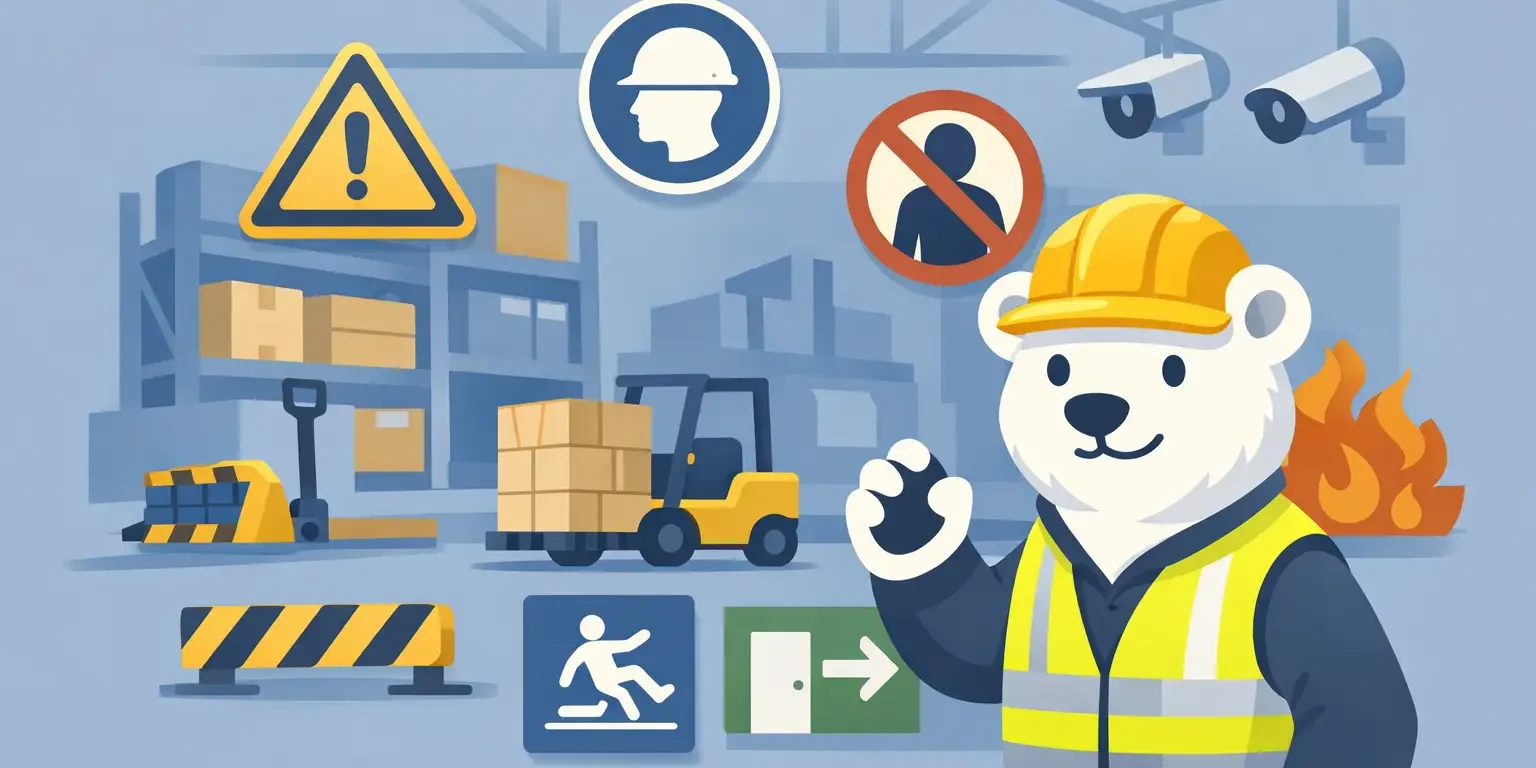
A near miss in a warehouse rarely comes out of nowhere. More often, it starts with a blind corner, an unclear walkway, a forgotten PPE rule, or a visitor stepping into the wrong area. That is why choosing the best signs for warehouse safety is not a box-ticking exercise. Good signage helps people make the right decision quickly, especially in busy spaces where vehicles, stock, staff and contractors all move at pace.
For warehouse and factory operators, the challenge is not simply putting more signs on the wall. It is choosing the right signs, in the right format, and placing them where they will actually be seen and understood. A cluttered site full of mixed messages can be almost as unhelpful as having no signage at all.
What makes the best signs for warehouse safety?
The best warehouse safety signs do three jobs well. They catch attention, they give clear instruction, and they stand up to the environment they are placed in. In practical terms, that means signs must be easy to read from the right distance, suitable for indoor or outdoor use, and matched to the actual risk on site.
A warehouse with high pedestrian traffic will need a different signage approach from a distribution centre with constant forklift movement. Cold stores, loading bays, racking aisles, dispatch areas and staff entrances all create different communication needs. There is no single sign pack that suits every operation.
Material also matters. In clean, dry indoor areas, standard rigid signage may be entirely suitable. In external yards or washdown zones, you need tougher options that can handle moisture, dirt, impact and temperature changes. This is where working with a supplier that understands production as well as layout can save time and rework.
The core safety signs every warehouse should consider
1. Forklift and vehicle warning signs
Where forklifts, pallet movers or site vehicles operate, warning signage is usually the first priority. These signs alert pedestrians to moving plant, crossing points and restricted vehicle zones. In many warehouses, the real risk is not speed alone but visibility. A forklift emerging from racking ends or passing through a shutter door gives people very little reaction time.
Clear vehicle warning signs work best when backed up by floor graphics, barrier systems or marked walkways. A wall sign on its own may not be enough in a noisy, fast-moving environment. If traffic routes change seasonally or by shift pattern, it may be worth reviewing whether fixed signs still reflect reality.
2. Pedestrian route and walkway signs
Warehouses function better when people know exactly where they should and should not walk. Signs for pedestrian routes, crossings and designated safe walkways reduce hesitation and help separate foot traffic from vehicles.
This category is often overlooked because floor markings do much of the visible work. Even so, overhead or wall-mounted route signage is useful at junctions, access points and long aisles where people need confirmation before committing to a route. It is especially helpful for visitors, agency staff and contractors who do not know the site.
3. PPE mandatory signs
Hard hats, hi-vis clothing, gloves, safety footwear, hearing protection and eye protection are common warehouse requirements, but they are not always needed in every zone. The most effective PPE signs are specific to the area and positioned before the person enters it.
A sign that says safety footwear must be worn is more useful at the threshold of a picking area than halfway through it. The same goes for hearing protection near noisy machinery or eye protection in maintenance and fabrication spaces. If every wall carries every instruction, staff begin to tune them out.
4. Fire exit and emergency escape signs
Emergency signage should never feel like an afterthought. Fire exit signs, directional escape signs and assembly point signs are essential because warehouses can be difficult spaces to navigate quickly under pressure. High racking, partitioned work zones and stacked stock can limit visibility and create confusion in an evacuation.
Photoluminescent options can add value where lighting may be reduced during an incident. In larger sites, consistency is critical. If escape signage changes style, size or direction from one area to another, people may hesitate when time matters most.
5. Hazard and restricted area signs
Danger signs for electrical rooms, charging stations, maintenance areas, chemicals, loading docks and machine zones help prevent people wandering into places they should not be. Restricted access signs are particularly important in mixed-use sites where warehouse operations sit alongside offices, trade counters or customer collection points.
This is one of the clearest examples of where off-the-shelf signs and bespoke signage may need to work together. Standard hazard symbols cover many risks, but site-specific messages often improve compliance. A simple “Authorised staff only” may not be enough if visiting drivers regularly enter the wrong bay.
Why placement matters as much as the sign itself
A well-made sign in the wrong place does very little. Warehouse signage needs to be positioned at the point a decision is made, not somewhere nearby. If a driver needs to reduce speed before a crossing, the sign must be visible early enough to change behaviour. If PPE is mandatory beyond a doorway, the instruction needs to appear before entry.
Height, sight lines and lighting all affect performance. Signs mounted too high can disappear above racking. Signs placed behind open doors, stretch-wrap stations or stacked pallets are effectively invisible. In some environments, larger format signage is the better option simply because the site is visually busy.
There is also a trade-off between permanence and flexibility. Fixed signs are ideal for long-term routes and rules, but temporary hazards, project zones and layout changes may call for short-run boards, decals or portable solutions. Warehouses evolve, and signage should keep up.
Choosing the right format for warehouse safety signs
Rigid boards are a dependable choice for most internal and external applications, particularly where durability matters. Self-adhesive vinyl can work well for smooth surfaces, doors, glazing and equipment labels, while floor graphics are useful for reinforcing routes and hazard zones. Hanging signs can help where wall space is limited or where visibility over stock and equipment is needed.
The right format depends on the surface, the environment and how long the message is expected to stay in place. A loading bay exposed to weather and knocks from equipment needs something different from an internal pedestrian corridor. This is why a one-supplier approach can be useful. It allows businesses to keep visual consistency while selecting the most suitable production method for each area.
Common mistakes that weaken warehouse safety signage
Too many sites suffer from signage overload. When every message is urgent, nothing stands out. Repetition can also become background noise, particularly for experienced staff who pass the same signs every day.
Another issue is inconsistency. Mixed colours, fonts, sizes and sign styles can make a site look pieced together and harder to read quickly. That is not just a branding concern. It affects how efficiently information is absorbed.
Out-of-date signage is another risk. Routes change, machinery moves, storage zones expand, and temporary arrangements become permanent. If signs do not match the current layout, they stop being trusted. At that point, even correct signage may be ignored.
How to review your warehouse signage properly
A practical review starts with movement. Walk the site as a picker, a forklift operator, a cleaner, a visitor and a delivery driver would. You will quickly spot where instructions are late, unclear or missing. Then look at each zone by risk level rather than by product type.
Ask simple questions. Where are people making decisions? Where are they likely to hesitate? Where could someone unfamiliar with the site take a wrong turn? Those answers usually tell you more than a basic sign count.
It also helps to review signage as part of wider workplace communication. Safety signs work best when they support floor markings, barriers, branded wayfinding and operational layout. In other words, they should feel like part of a joined-up site, not separate bits added over time. For businesses managing multiple locations, that consistency becomes even more valuable.
SignsDisplay.com supports warehouses, factories and commercial sites with practical signage production across a wide range of formats, helping businesses source the right visual solutions through one dependable supplier relationship.
The best signs for warehouse safety are the ones people act on
The best signs for warehouse safety are not necessarily the biggest or the most numerous. They are the ones that are clear, durable and placed exactly where people need them. When signage reflects how your warehouse actually operates, it supports safer movement, better compliance and fewer avoidable mistakes.
If a sign helps someone stop, turn, wear the right kit or avoid the wrong area at the right moment, it is doing its job. That is the standard worth aiming for on any site.