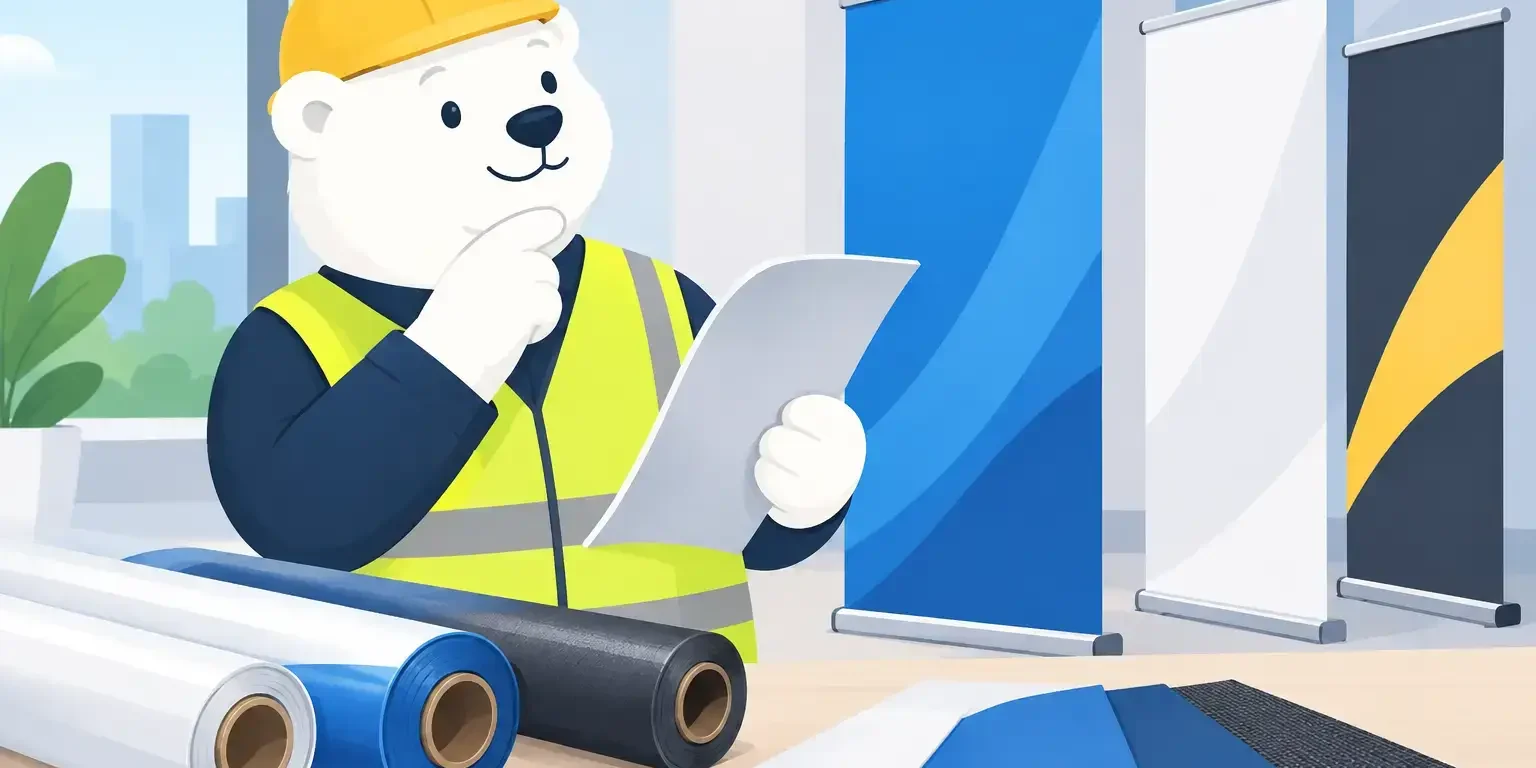
A banner that looks sharp in a meeting room can fail quickly on a windy building site. Equally, a heavy-duty outdoor vinyl may be unnecessary for a one-day retail launch. Knowing how to choose banner materials starts with where the banner will be used, how long it needs to perform, and how it will be fixed in place.
For UK businesses managing promotions, site communication or branded environments, material choice affects far more than appearance. It influences print quality, resistance to weather, handling, installation, storage and replacement costs. The right answer is rarely simply the cheapest banner material or the thickest one. It is the material that suits the job.
Start with the banner’s working environment
Before selecting a finish or requesting prices, establish the banner’s practical conditions. Is it for a retail interior, an exhibition stand, a shopfront, a property development, a fence line or a factory floor? Will people view it close up, or from the other side of a road? Is it expected to be installed for a weekend, several months or longer?
Indoor banners are protected from rain, UV exposure and wind, so the priority is often a clean printed finish, accurate brand colour and straightforward handling. Outdoor banners need to withstand changing weather, tension and movement. A banner on scaffold, railings or temporary fencing also needs to allow enough air through to reduce strain on the material and its fixings.
Think about the setting as well as the weather. In a warehouse, a banner might need to remain readable under artificial lighting and work around operational traffic. At an estate agency branch or housing development, it may need a polished presentation from close range. A construction site banner has different priorities: clear messaging, durable finishing and a practical mounting method.
How to choose banner materials by application
PVC vinyl for dependable all-round use
PVC vinyl is a familiar choice for external banners because it is durable, waterproof and produces strong, vibrant graphics. It is well suited to promotions, shopfront displays, event branding, building-site messaging and temporary advertising. Standard frontlit PVC gives a solid, opaque surface that handles colour blocks, logos and large-format text well.
For many short-to-medium-term outdoor applications, PVC offers a sensible balance of cost and performance. It can be finished with hems and eyelets for cable ties, bungee cords or rope, making it practical to install on fencing, railings and frames.
However, PVC is not automatically the best choice for every location. A solid banner in an exposed position can catch the wind like a sail. The fixing points, rather than the print itself, are often where problems begin. For a wind-prone site, a mesh alternative is normally worth considering.
Mesh banners for fencing, scaffolding and exposed sites
Mesh banner material has small perforations that allow wind to pass through. This reduces wind loading and makes it a strong option for construction hoarding, scaffold wraps, perimeter fencing, sports grounds and large outdoor installations.
From normal viewing distances, printed mesh still delivers a clear visual message. Up close, the perforated structure is more noticeable and colours can appear less dense than on solid vinyl. This is the trade-off: improved airflow and lower stress on the installation, in return for a slightly less solid printed surface.
Mesh is particularly useful when a banner will be fitted to Heras fencing or open railings. The material is only one part of the decision. Use suitable reinforced hems, correctly spaced eyelets and enough fixings to spread the load. A well-specified mesh banner with poor installation can still flap, stretch or tear in strong wind.
Blockout material for double-sided messages
Where a banner will be viewed from both sides, blockout PVC is often the right solution. It contains an opaque layer that stops graphics or light showing through from the reverse. This makes it suitable for hanging displays, lamp-post brackets, retail windows and freestanding applications where both sides need to look professional.
Standard single-sided vinyl can be printed on both sides in some circumstances, but without a blockout layer the images may show through or reduce legibility. If both faces matter, specify the requirement at the outset rather than treating it as an afterthought.
Fabric and polyester for interiors and events
Fabric banners offer a softer, more premium appearance than PVC and are especially effective for exhibitions, conferences, office interiors, retail point-of-sale displays and photographic backdrops. Polyester fabric is lightweight, easier to transport and less prone to glare under exhibition or showroom lighting.
Fabric is commonly used in tension-frame graphics and portable display systems, where a smooth, crease-resistant finish helps the message look considered. It can also be a good choice where a business wants a less industrial feel than vinyl provides.
The limitation is that not every fabric banner is designed for prolonged outdoor exposure or heavy handling. Some fabrics are washable and reusable, while others are best reserved for protected environments. If the banner will travel frequently between venues, discuss how it will be folded, packed and installed before choosing the material.
PVC-free options when environmental aims matter
Businesses reviewing their display materials may wish to consider PVC-free banner options. These can provide a practical alternative for certain indoor and outdoor campaigns, particularly where environmental procurement requirements or disposal considerations influence the brief.
The best choice depends on the intended lifespan, print method, finish and end-of-life route available locally. A material described as PVC-free is not a universal answer to sustainability questions. A banner that lasts for repeated use, is correctly specified and is not replaced unnecessarily can be a more responsible choice than a poorly chosen material that fails early. Ask for advice based on the precise application rather than selecting on one claim alone.
Match print quality to viewing distance
Material and print design need to work together. Large external banners are commonly read from a distance, so bold colour, clear contrast and concise wording are usually more valuable than intricate detail. PVC and mesh can both be highly effective for this type of communication.
For close-viewed displays, such as reception graphics, exhibition panels or window messaging, fine text, imagery and brand colour reproduction become more important. Smooth vinyl, blockout media or fabric may be better suited, depending on the system and lighting.
Do not overlook glare. Glossy surfaces can make colours appear punchy, but reflections from shop lighting or direct sun can affect readability. A matt finish can reduce reflections and give a more refined look, particularly indoors. The best finish depends on the lighting conditions and the viewing angle, not just a preference for matt or gloss.
Specify the finishing and fixing method early
A banner is only as reliable as its finishing. Hems reinforce the edges, while eyelets create fixing points. Pole pockets allow the banner to slide onto a rail or support bar. Keder edging is used with compatible track systems, providing a neat, tensioned result for exhibition, retail and building applications.
These details affect which material will perform best. A large banner with eyelets needs sufficient reinforcement around its perimeter. A tensioned frame may require a material with controlled stretch. A banner attached to temporary fencing should allow for multiple fixing points and slight movement, rather than being pulled tight at only four corners.
It is also worth considering access. If a facilities team will change graphics regularly, a lighter material or reusable frame system can reduce handling time. If an installer is fitting a large exterior banner at height, dimensions, weight, fixing arrangement and site conditions all need to be planned before production.
Consider lifespan, reuse and total cost
A low initial price can be misleading if a banner needs replacing after a short period. For a one-off sale or event, a straightforward PVC banner may be entirely appropriate. For a recurring campaign, a durable material and reusable hardware may offer better value over time.
Ask whether the artwork is likely to change. If the message is seasonal but the display location is permanent, it may make sense to invest in a reusable frame or banner system and replace only the graphic. If the message needs to remain unchanged for months outdoors, prioritise material strength, UV-resistant print and suitable finishing.
Storage matters too. A banner that is carefully cleaned, dried and rolled rather than folded can often be reused in better condition. Fabric graphics should be stored according to their system requirements, while PVC banners should be protected from sharp edges and excessive heat.
Give your supplier the practical brief
The fastest route to the right specification is a clear brief: banner size, location, expected duration, whether it is indoors or outdoors, likely wind exposure, viewing distance, fixing method and artwork requirements. Photographs of the intended installation area can be useful, especially for fences, scaffold, shopfronts and unusual structures.
SignsDisplay.com can help businesses turn that information into a practical banner specification, including material, print, finishing and installation considerations. This avoids ordering a generic product that looks fine on a screen but is unsuitable once it reaches site.
Choose the banner material around the job it has to do, not simply the product name. When the setting, fixing and lifespan are considered together, the finished banner has a far better chance of looking right, staying secure and representing your brand properly from day one.