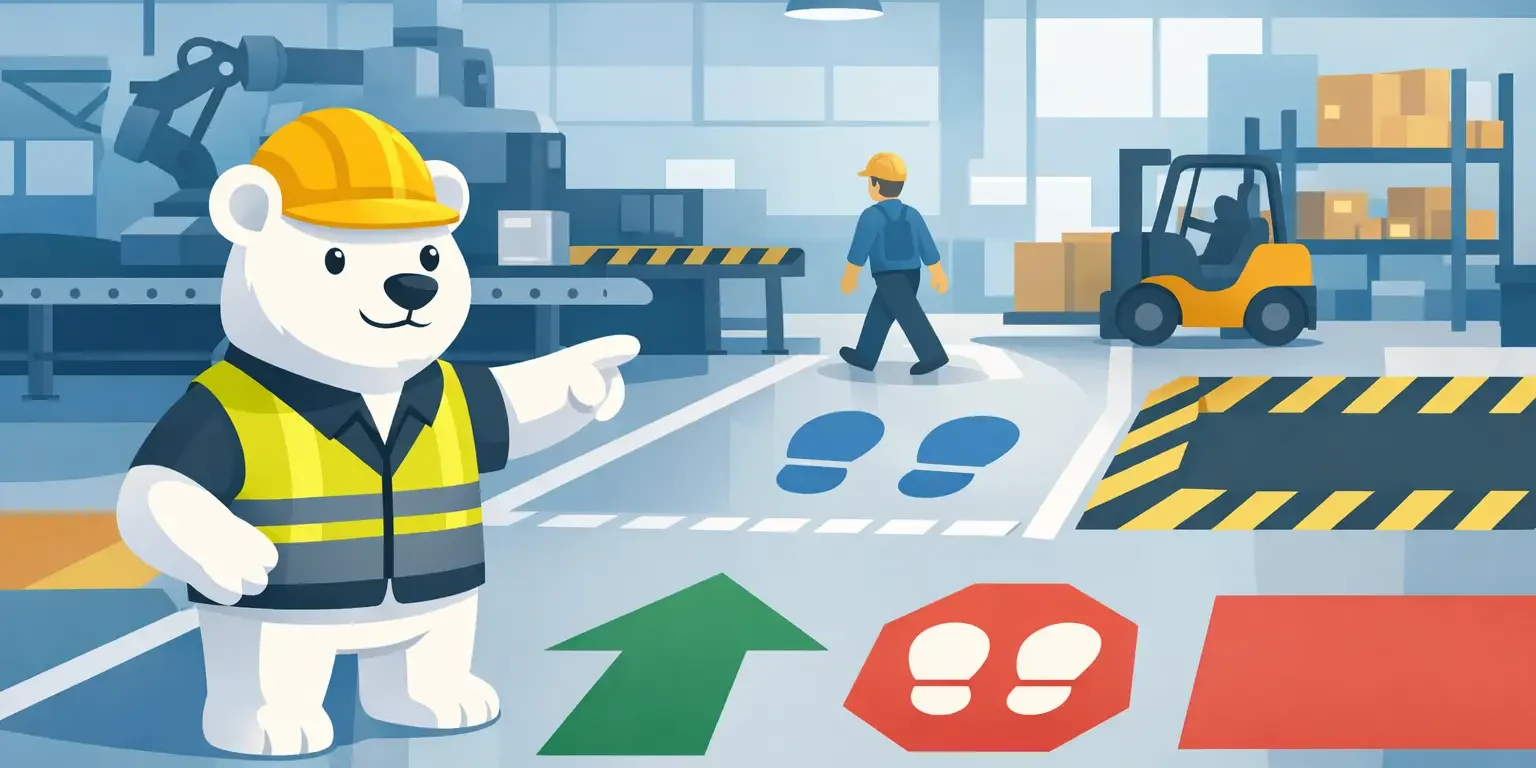
A forklift route that fades in six weeks is not a safety system. It is a maintenance problem waiting to happen. That is why factory floor graphics need more thought than simply choosing a bright colour and sending a file to print.
In active production spaces, floor graphics do several jobs at once. They help people move safely, separate pedestrian and vehicle traffic, mark storage areas, reinforce process steps and support audits. They can also bring a site into line with wider workplace branding, which matters more than many teams expect when visitors, customers and staff are all reading the same environment. Done well, they reduce confusion. Done badly, they peel, scuff, create visual clutter or get ignored.
What factory floor graphics are really for
Most businesses first look at floor graphics because they need clearer safety marking. That is often the right starting point, but it is rarely the whole brief. On a busy factory floor, graphics also shape behaviour. They show where materials should sit, where people should queue, where checks happen and where equipment belongs when it is not in use.
That matters because painted lines and printed floor graphics are not just decorative markings. They are part of workplace communication. If a site relies on memory, verbal instruction and temporary tape, standards drift quickly. If the space itself tells people what good looks like, consistency becomes much easier to maintain.
There is also a practical brand point here. In manufacturing, warehousing and fulfilment environments, visual order sends a message. It tells staff that standards matter. It tells visitors the site is controlled and well run. For sectors where audits, compliance visits or customer walk-rounds are common, that visual impression has commercial value as well as operational value.
Where factory floor graphics make the biggest difference
The strongest results usually come from high-decision areas. These are the points where people need instant clarity without stopping to ask a question. Pedestrian walkways are an obvious example, but they are only one part of the picture.
Goods-in zones often benefit from floor graphics because they are naturally busy, with pallets, cages, lorries unloading and multiple teams crossing paths. Marking receiving lanes, inspection spaces and temporary holding areas reduces the chance that stock starts to spread into circulation routes.
Production cells are another common need. When workstations, component bins, waste points and quality check areas are clearly marked, teams spend less time correcting avoidable issues. The same applies to dispatch areas, where lane discipline and loading preparation can easily slip when volumes rise.
Emergency equipment points, fire exits and exclusion zones also need careful treatment. Here, visibility is everything, but so is restraint. If every square metre is marked, the truly critical information gets lost in the noise.
Choosing the right type of floor graphic
Not every factory floor graphic should be handled the same way. The right solution depends on traffic, cleaning methods, floor condition and whether the message is permanent or likely to change.
For long-term route marking and zoned areas, durable floor vinyls or specialist industrial graphics can work well, provided the surface is suitable and the product is matched to the environment. In some settings, printed graphics offer more flexibility than paint because they can include symbols, text, numbering and branded colour coding in one application.
That said, permanence is not always the goal. Lean manufacturing layouts evolve. Warehouse slotting changes. Temporary distancing or campaign messaging may only be needed for a defined period. In those cases, removable or shorter-life materials can be the better commercial choice. A graphic that is easy to update may save more over time than a tougher option that becomes awkward to replace.
Slip resistance matters too. A glossy printed surface may look sharp in a sales environment, but factory floors demand materials designed for heavy footfall and, where relevant, mechanical traffic. Cleaning chemicals, dust, moisture and abrasion all affect lifespan. A product that works well in a retail aisle may fail quickly beside a packing line.
Design matters more than people think
Many floor graphic projects fail at the design stage rather than the production stage. The issue is not usually print quality. It is that too much information gets pushed onto the floor, or the visual system has no internal logic.
Good floor graphics use hierarchy. The most important messages should be the easiest to read at a glance. Route colours need to mean something consistent. Symbols should be familiar. Text should be short and placed only where it genuinely adds clarity.
This is where a joined-up signage approach helps. If wall signs, hanging signs, machine labels and floor graphics all use different terminology or conflicting colours, users hesitate. If the entire site follows one visual language, navigation becomes more intuitive.
There is also a balance between safety and brand presentation. Some businesses want purely functional markings. Others want graphics that reflect company colours, site identity or customer-facing standards. Both are reasonable. The answer depends on the environment. In many cases, you can bring in brand cues without undermining legibility, but compliance and readability should lead the decision.
Installation and preparation are where longevity is won
A high-quality graphic applied to the wrong surface will still fail. Surface preparation is one of the biggest factors in whether factory floor graphics last.
Floors need to be properly cleaned, dry and stable before application. Dust, grease, old adhesive, flaky paint or surface damage all reduce bond strength. Temperature can affect installation too, particularly in colder months or in spaces with variable conditions. If the floor has cracks, contamination or moisture issues, those need to be addressed first rather than covered up.
Timing is another practical concern. Many factories cannot stop for long, so installation often has to work around shifts, planned downtime or sectional access. That is one reason businesses tend to favour suppliers who can advise not only on print production, but on fit-for-purpose materials and realistic rollout planning.
Large or multi-zone sites especially benefit from a phased approach. It is often better to prioritise the highest-risk or highest-traffic areas first, then extend the system once the layout is proven in use.
Common mistakes to avoid
The first mistake is treating floor graphics as a standalone purchase. If the objective is safer movement, cleaner zoning or clearer process control, the graphics need to sit inside a wider site communication plan.
The second is over-marking. It is tempting to label everything, particularly after an audit finding or a site incident. But if every route is a different colour and every area has multiple messages, the floor becomes harder to read, not easier.
The third is choosing solely on unit price. Cheap materials can look similar on day one, but the real cost appears later in lifting edges, premature wear, replacement labour and avoidable disruption. For busy operational spaces, value comes from suitability and service life, not just initial spend.
The fourth is failing to think about future change. A layout that works now may not suit a revised process in six months. It is worth deciding from the outset which graphics should be long-term and which need flexibility.
A practical way to plan factory floor graphics
The best starting point is not a print specification. It is a site walk-through. Look at where people hesitate, where materials drift out of place, where near misses happen and where visitors need guidance. Those pressure points usually reveal the graphics that will deliver the strongest return.
Next, decide what each marking is meant to achieve. Safety separation, storage control, process discipline and navigation are not identical jobs, and they may need different visual treatments. Once that is clear, materials and print methods become much easier to select sensibly.
It also helps to think beyond the floor itself. In many environments, the best result comes from combining floor graphics with wall signage, labels, boards and wayfinding so that messages are reinforced rather than repeated. That joined-up approach is where an experienced production partner can add real value, especially for businesses managing multiple sites or mixed operational needs. SignsDisplay.com Ltd works with exactly these kinds of requirements, where speed, durability and consistency all matter.
Factory floor graphics are most effective when they earn their place – clear enough to guide, tough enough to last, and flexible enough to reflect how your site actually works.