

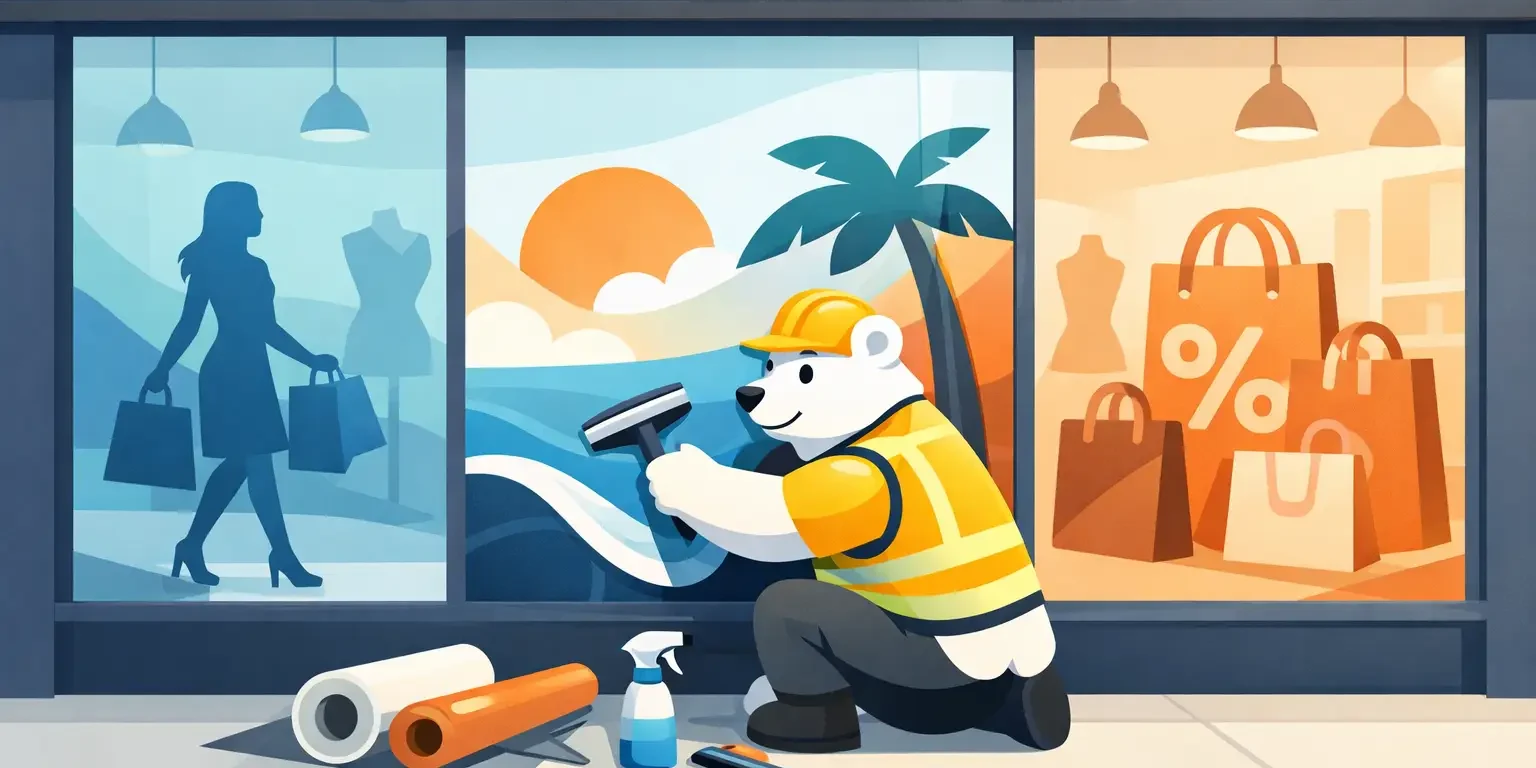
A shopfront has a few seconds to do its job. Before a customer sees your products, pricing or staff, they see the glass. That is why choosing the best window graphics for retail is less about decoration and more about how clearly your store communicates from the pavement.
The right graphic can stop passing trade, support promotions, improve privacy, and make a unit look established even before someone walks through the door. The wrong one can block light, peel early, look dated, or leave your frontage cluttered. For retail operators and marketing teams, the best choice usually comes down to one practical question – what does the window need to do?
What the best window graphics for retail need to achieve
Retail window graphics work hardest when they have a clear purpose. Some shops need bold seasonal messaging that can be changed quickly. Others need a more permanent branded look that carries across multiple sites. In some cases, privacy matters just as much as promotion, especially for salons, clinics, betting shops, or units where stock and equipment should not be fully visible from outside.
Good window graphics should be readable at a glance, consistent with the wider brand, and suitable for the environment they sit in. A busy high street frontage has different demands from a retail park unit or an internal shopping centre window. Sunlight, footfall direction, viewing distance and cleaning routines all affect what will perform well over time.
This is where material choice matters. Retail buyers often focus on artwork first, but the substrate and finish decide how the graphic will look in use, how long it will last, and how easy it will be to remove or update.
Full-cover printed vinyl for maximum impact
If the aim is visibility, full-cover printed vinyl is often one of the best window graphics for retail environments. It gives you a large-format canvas for brand colours, campaign visuals, product imagery and promotional messages. From a distance, it can turn plain glazing into a strong advert for the business.
This option works particularly well for store launches, refits, short-term campaigns and vacant unit dressing. It can also help make a partially fitted or low-stock unit look more intentional while work continues inside. For retail chains or multi-site operators, full-cover graphics are useful when consistency matters across different branches.
The trade-off is natural light. A fully covered window changes the feel inside the store and may not suit every layout. If your products rely on daylight or you want a more open frontage, a partial coverage design or perforated film may be a better fit.
Perforated window film for one-way effect
Perforated window film is a strong choice when you want to advertise outwardly without fully losing visibility from the inside. Printed on the outside face, it appears solid from the street, while the perforation allows people inside to see out reasonably well during daylight.
For retailers, this can be a useful middle ground. You keep branding and campaign space on the glass, but avoid the closed-off feel that comes with a solid block of vinyl. It suits convenience stores, phone shops, pharmacies, salons and a wide range of high street units where staff still need some external visibility.
It does depend on lighting conditions. The one-way effect is strongest when it is brighter outside than in. At night, with internal lighting on, visibility can change. It is also not the best choice for very fine text or highly detailed imagery, as the perforation affects clarity at close range.
Cut vinyl lettering for clean branding
When you want a smarter, more permanent look, cut vinyl lettering and logos are often the simplest answer. This style suits retailers that need opening times, logos, payment information, directional messages or understated branding across the glass without filling the whole window.
It is especially effective for boutiques, estate agents, cafés, showrooms and service-led retail where a clean frontage supports the brand better than heavy promotional graphics. Frosted cut vinyl can also add a more premium finish while improving privacy.
The main advantage is clarity. Cut vinyl is crisp, tidy and cost-effective, especially for straightforward messaging. The limitation is obvious enough – it is not designed for image-heavy campaigns or attention-grabbing sale windows. If your store changes promotions every few weeks, this is better used as a base branding layer rather than the main campaign tool.
Frosted and etched-effect films for privacy and style
Frosted window graphics sit in a useful space between branding and function. They soften visibility through the glass, help define areas inside the store, and create a more finished appearance. For retail settings with consultation spaces, treatment rooms, fitting areas or desk zones near the entrance, frosted film can improve privacy without making the frontage feel shut off.
This style also works well for internal retail glazing, where wayfinding, branded manifestation, or subtle zoning is needed. Patterned or cut frosted graphics can carry logos and brand shapes in a restrained way that still feels considered.
They are not built for promotional punch. If your priority is driving footfall with offers and product-led messaging, frosted films are a supporting element rather than the headline act. But for businesses where professionalism and privacy matter, they can be one of the most effective long-term investments on the glass.
Sale decals and campaign graphics for short-term promotions
Retail never stands still. New lines arrive, offers change, and seasonal campaigns need to move quickly. For that reason, removable sale decals and short-term promotional graphics remain one of the most practical window solutions available.
These can be applied as bold percentage-off messaging, product callouts, seasonal themes, event notices or launch announcements. They are useful because they are fast to produce, easy to understand from outside, and relatively simple to replace when the campaign ends.
The key is discipline. Too many decals, layered over time, can make a window look chaotic. Campaign graphics should be sized properly, positioned with intent, and removed cleanly once they are no longer relevant. A cluttered sale window can reduce trust just as quickly as it gains attention.
How to choose the right option for your store
The best window graphics for retail stores are not always the most elaborate. They are the ones matched properly to the site, the brand and the campaign cycle.
If your window needs to act as a billboard, printed vinyl or perforated film makes sense. If the goal is brand presence with a cleaner finish, cut vinyl may be enough. If privacy is part of the brief, frosted film often earns its place. If you run frequent promotions, removable campaign graphics give you the flexibility to keep pace.
It is also worth thinking about installation and replacement from the start. A single independent shop may be happy to update its own decals, but larger rollouts or premium finishes usually benefit from a production partner that can manage artwork, print consistency, materials and fitting across multiple locations.
Design choices that improve results
Even the best material can underperform if the design is wrong. Window graphics need stronger hierarchy than many people expect. Customers are usually walking or driving past, not standing still to study the glass. That means the message has to land quickly.
Large text, strong contrast and limited copy usually work better than trying to say everything at once. If you are promoting a sale, lead with the offer. If you are launching a store, lead with the opening message. If the shopfront already has fascia signage carrying the business name, the window does not need to repeat it three more times.
Graphics should also work from both near and far. Fine detail may look impressive on screen but disappear in real conditions. A practical supplier will flag that before production, which saves wasted print and disappointing results on site.
Durability, maintenance and replacement
Retail graphics live in hard-working environments. Sunlight, condensation, cleaning chemicals and constant public exposure all affect lifespan. A short-term promotion does not need the same specification as a permanent branded installation, but both need to be fit for purpose.
Cheap material often shows its weakness at the edges first. Shrinkage, lifting and fading do not just look untidy – they make the whole business appear less cared for. For customer-facing environments, that is an avoidable problem.
It is usually better to think in terms of planned replacement than trying to stretch graphics beyond their intended life. Seasonal campaigns should come down when the season ends. Permanent branding should be checked periodically, especially on south-facing glass or high-traffic frontages.
For businesses managing several stores, consistency matters just as much as durability. Working with one supplier that can handle design support, manufacture and fit can reduce delays and avoid the patchy look that happens when each site improvises its own solution.
Window graphics are often treated as a finishing touch, but in retail they do much more than finish a space. They sell, direct, reassure and shape first impressions before a customer has even touched the door. If the glass on your frontage is doing too little, or trying to do too much, it may be time to give it a clearer job.


2 Comments