A poster in a shop window, a branded hoarding around a building site, directional signs across an office, graphics on a van fleet – if it needs to be seen clearly and look professional at scale, it usually comes back to one question: what is large format printing?
Large format printing is the process of printing oversized graphics onto materials used for signage, display, branding and workplace communication. It covers far more than posters. For most businesses, it includes everything from banners, exhibition graphics and point of sale displays to wall vinyls, floor graphics, estate agent boards, vehicle decals and outdoor signs.
What is large format printing used for?
Large format printing is used anywhere a business needs visual impact, clear information or durable branding in a physical space. That could be a retail window promotion, health and safety signage in a warehouse, wayfinding in an office, a branded backdrop at an exhibition or marketing boards on a development site.
The reason it matters is practical. Standard print is designed to be held in the hand or viewed up close. Large format print is designed to work across distance, environment and scale. It has to stay legible from several metres away, hold its colour well, and suit the surface or structure it is being applied to.
For commercial buyers, this is where the category becomes broader than many expect. A single campaign or site often needs multiple printed elements working together – external signage, internal branding, temporary promotional graphics, safety signs and supporting display materials. That is why large format printing is often part of a wider signage and visual communications brief rather than a one-off print order.
How large format printing works
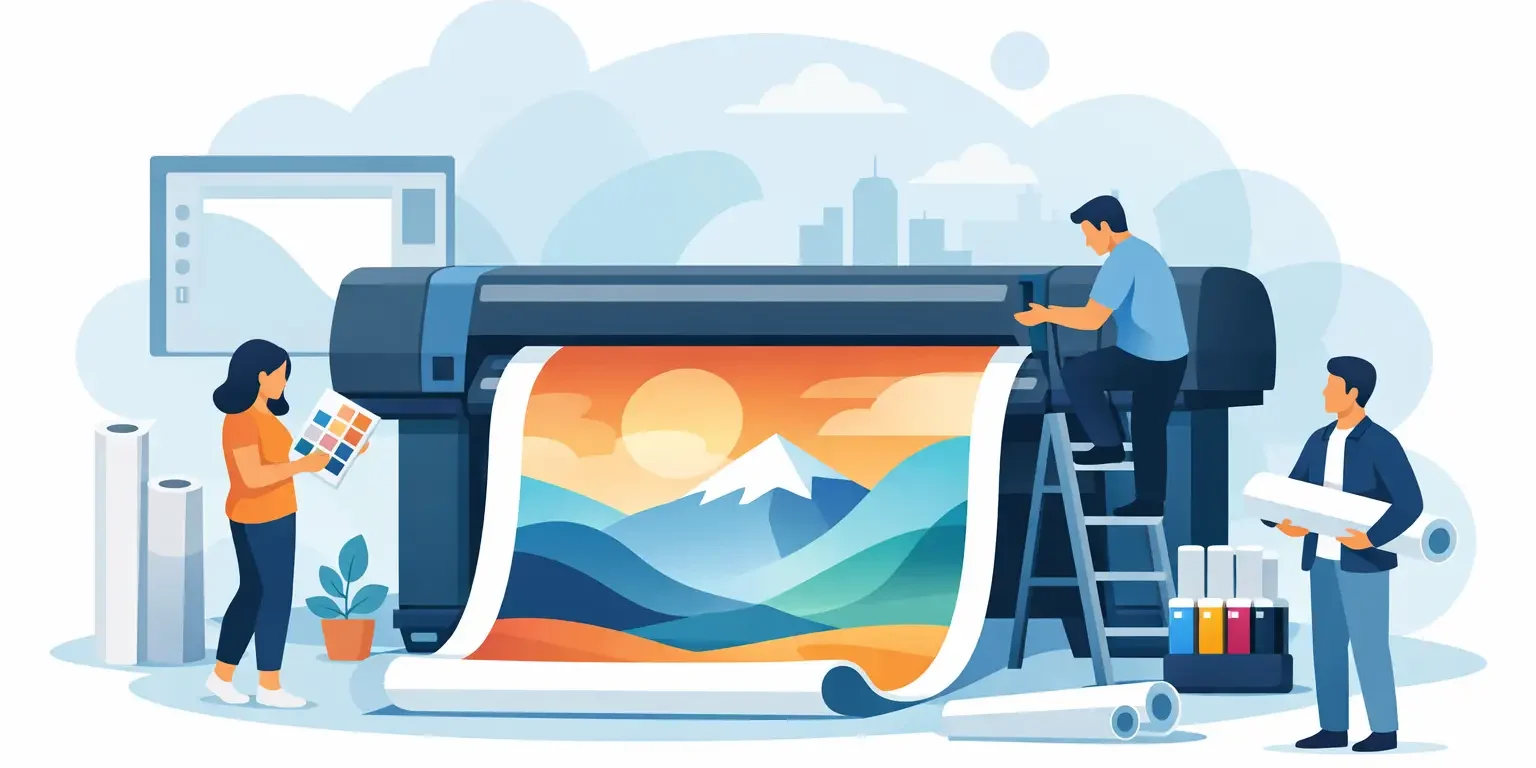
At its simplest, large format printing uses specialist printers built to handle wider media sizes than standard office or digital print equipment. These machines print onto rolls or rigid sheets depending on the product.
Flexible materials include PVC banner, self-adhesive vinyl, poster paper, canvas and film. Rigid materials include Foamex, correx, aluminium composite, acrylic and other boards used for signs, panels and display systems. The print may then be laminated, mounted, contour-cut, welded, eyeletted or finished for installation.
That finishing stage matters just as much as the print itself. A banner intended for windy external use needs different reinforcement from a pull-up display for an indoor event. Window vinyl may need reverse printing or specific adhesives. Site boards need the right substrate for weather exposure and fixing method. Good results come from matching artwork, print method, material and finishing to the job rather than treating every product as the same.
The main types of large format print
Most business buyers come across large format printing in a few key forms.
Signage is the most obvious. This includes shop fascia panels, factory signs, directional signs, safety signs, estate agent boards and branded site signage. Some of these are temporary. Others are built for long-term outdoor use and need stronger materials and fabrication.
Display graphics are another major category. Exhibition stands, roller banners, pop-up systems, backdrops and point of sale graphics all sit here. These products are often chosen for portability, ease of set-up and clean brand presentation.
Vinyl graphics cover a wide range of applications, from window manifestations and wall graphics to floor vinyls and vehicle livery. They are particularly useful where branding needs to fit an existing surface rather than a freestanding sign or display.
There is also a crossover with specialist production. Labels, decals, engraved panels, cut shapes and fabricated display elements can all form part of a large format project, especially when businesses want one supplier to handle the full package.
What is large format printing not?
It is not just “big posters”, and it is not only for marketing teams.
Operations teams use it for workplace communication and compliance. Site managers use it for safety, access and project signage. Facilities teams use it for wayfinding and internal environment graphics. Estate agency and property businesses use it for boards and promotional displays. Retailers use it to support launches, promotions and seasonal campaigns.
It is also not always about maximum size. A graphic can still be classed as large format if it is produced on specialist wide-format equipment and intended for signage, display or environmental branding. The key difference is use case, substrate and viewing distance, not just dimensions.
Why businesses choose large format printing
The biggest advantage is visibility. Large format print helps businesses communicate clearly in real-world environments where people are walking, driving, browsing or working. It gives a brand presence that standard documents and screens cannot replace.
It is also versatile. The same campaign can be adapted across windows, walls, vehicles, boards and event displays so branding stays consistent across locations. For businesses managing multiple sites or frequent promotions, that consistency is valuable.
Then there is durability. When specified properly, large format materials are built for their setting. External signage can withstand weather. Floor graphics can cope with foot traffic. Vehicle vinyl can handle daily use. That makes it a practical investment rather than a short-lived visual extra.
There is, however, always an “it depends” element. The right specification changes according to lifespan, budget, installation method and environment. A short-term indoor promotion does not need the same material as a permanent exterior sign. Spending more than necessary is avoidable, but so is under-specifying a product that needs to last.
Choosing the right material for the job
Material choice is usually where experience pays off.
For temporary outdoor promotions, PVC banners and correx boards are common because they are cost-effective and quick to produce. For longer-term external signs, aluminium composite or fabricated sign trays may be more suitable because they offer better rigidity and weather resistance.
For indoor branding, self-adhesive vinyl, wall coverings, acrylic panels and display films each have their place. In retail, finish and surface appearance tend to matter more. In industrial settings, durability and clarity often take priority.
Print quality matters too, but not always in the way people assume. A wall graphic viewed from one metre needs different detail from a roadside sign seen from passing traffic. Resolution, colour management and substrate finish should be judged in context. The sharpest possible print is not always the point – the right print for the viewing distance is.
Design and installation are part of the result
Large format printing works best when design, production and fitting are considered together.
Artwork that looks fine on a screen can fail on a three-metre board if text is too small, contrast is poor or key information sits where fixings or frame systems interrupt it. Equally, a well-printed graphic can still underperform if it is installed badly, applied to the wrong surface or supplied in the wrong format for site conditions.
That is why many businesses prefer a supplier that can handle more than output alone. When the same partner can advise on materials, prepare artwork, manufacture the graphics and support installation, projects tend to run more smoothly and brand standards stay tighter. For organisations juggling multiple product types, that joined-up approach cuts down supplier management and avoids mismatched results.
What to ask before placing an order
Before ordering large format print, it helps to be clear on a few practical points: where it will be used, how long it needs to last, how it will be fixed or displayed, and whether the graphic needs to match existing brand assets across other items.
Lead time matters as well. Some jobs are straightforward print-and-finish pieces. Others involve site surveys, fabrication, board erection, specialist materials or coordinated installation. If your project includes several elements, such as signs, displays and branded support print, it is usually more efficient to scope the full requirement at the start.
If you are unsure what product you need, that is normal. Most commercial buyers are not expected to know whether a job needs monomeric vinyl, laminated Foamex or a tension fabric system. What matters is explaining the environment, objective and timescale so the specification fits the real use.
What is large format printing really about?
For businesses, large format printing is not just about producing something bigger. It is about making branding, information and messaging work properly in physical spaces – on site, in store, on the road and across the workplace.
At SignsDisplay.com, that usually means looking beyond a single printed item and considering the full environment around it. When your signage, display graphics and branded materials work together, the result feels more professional, more consistent and easier to manage.
If you are asking what is large format printing, the most useful answer is this: it is the practical side of visible business communication. Get the specification right, and it does more than fill a space – it helps people find you, understand you and trust what they see.