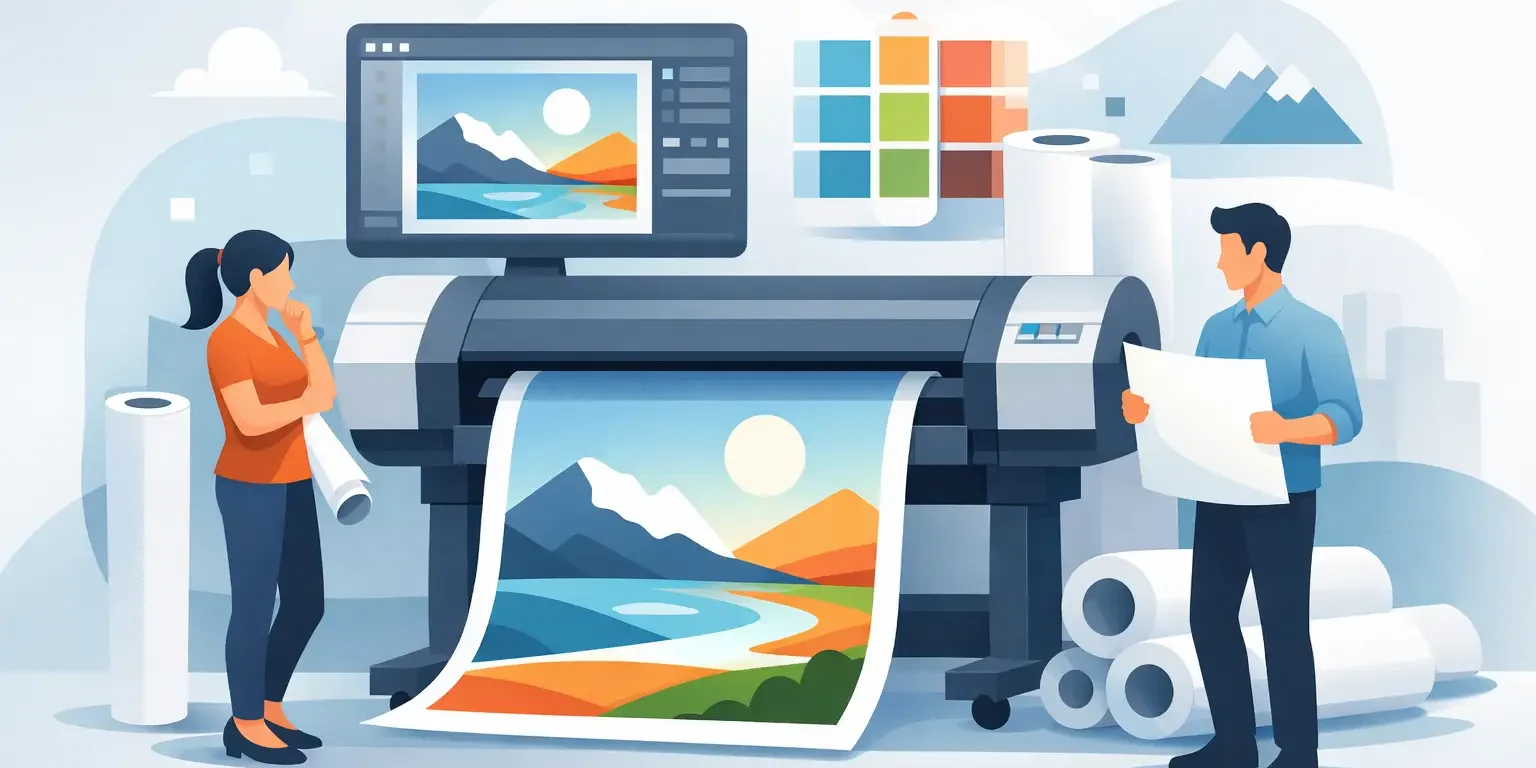
A roller banner in reception, hoarding around a new development, graphics across a van fleet, wayfinding in an office, promotional boards in an estate agent window – these are all familiar examples of what is wide format printing in practice. It is the part of print production built for scale, visibility and durability, helping businesses communicate clearly across physical spaces.
For many organisations, wide format printing is less about a single product and more about solving a practical problem. You may need stronger brand presence in-store, safer navigation on site, temporary campaign graphics for an event, or durable outdoor signage that can cope with British weather. Wide format print is the production method behind that kind of work.
What is wide format printing and how does it work?
Wide format printing refers to printing on materials that are too large for standard desktop or office printers. It is used to produce oversized graphics, signage, displays and visual communication materials on a wide range of substrates. That can include vinyl, banner PVC, paper, fabric, rigid boards, window film and specialist materials designed for indoor or outdoor use.
The “wide format” part simply means the machinery can print much wider media rolls or larger sheets than conventional printers. In commercial production, that allows businesses to create everything from posters and exhibition panels to site boards, wall graphics and vehicle decals.
The process itself depends on the job. Some applications are printed roll-to-roll, which suits flexible materials such as self-adhesive vinyl, banner material and posters. Others are printed direct to board, which is often the better option for rigid materials such as Foamex, Correx, Dibond or display boards. The print is then finished to suit the end use, whether that means trimming, mounting, laminating, contour cutting, eyeleting, sewing, application to panels or preparation for installation.
That finishing stage matters as much as the print. A graphic intended for a shop window has very different requirements from a roadside sign or construction hoarding. Good wide format production is not just about size. It is about making sure the finished item is fit for purpose.
Where wide format printing is used
Wide format printing sits across far more business functions than many buyers first expect. Marketing teams use it for campaigns, retail POS, exhibition systems and branded environments. Facilities and operations teams rely on it for health and safety signage, internal communication boards, wayfinding and workplace graphics. Property, construction and development businesses use it for estate agent boards, site signage, directional systems and perimeter branding.
It is also central to vehicle graphics, window manifestations, wall coverings, promotional banners, flags, pavement signs and temporary event branding. If a message needs to be seen clearly from a distance, applied across a surface, or produced at a size that standard print cannot handle, wide format is usually the answer.
This is why businesses often benefit from working with a supplier that can handle multiple product categories under one roof. A rebrand, a new branch opening or a site launch rarely needs just one item. It may involve external signs, internal panels, window graphics, branded boards, promotional material and installation support all at once.
The main materials used in wide format print
Material choice has a direct impact on performance, appearance and cost. There is no single best option for every job.
For short-term outdoor promotions or event branding, banner PVC is often a practical choice. It is cost-effective, durable enough for temporary use and easy to finish with hems and eyelets. For retail windows, self-adhesive vinyl gives a clean branded finish and can be produced for short-term campaigns or longer-term display.
For rigid signage, boards such as Foamex, Correx and aluminium composite are common. Correx is often chosen for temporary site and estate agent boards because it is lightweight and economical. Foamex offers a more solid presentation for interior display and medium-term signage. Aluminium composite materials are typically used where a smarter, longer-lasting finish is needed outdoors.
Fabric is another option, particularly for exhibition stands, backdrops and soft signage. It can look premium and travels well, but it is not right for every environment. Likewise, paper posters remain useful for indoor campaigns, yet they will not hold up in the same way as laminated or mounted graphics in tougher settings.
The right decision usually comes down to where the graphic is going, how long it needs to last, the surface it is being applied to and the level of finish expected.
Why businesses choose wide format printing
The first reason is visibility. Large graphics work because they are easy to spot and easy to read. In a retail environment, that can mean stronger promotion at the point of sale. On a construction site, it can mean clearer instruction and safer movement. In an office, it can help with wayfinding and internal communication.
The second reason is versatility. Wide format print can support branding, compliance, promotion and navigation at the same time. A business can apply one visual standard across reception areas, windows, meeting rooms, vehicles, exterior signs and event spaces.
The third is speed. Compared with some fabricated signage methods, printed solutions can often be produced and deployed quickly, which matters when deadlines are tight. That said, speed depends on artwork readiness, material availability, finishing requirements and whether installation is involved.
There is also a cost consideration. Wide format printing can deliver strong visual impact without the higher investment associated with some permanent sign systems. For campaigns, temporary launches, seasonal retail activity or changing property stock, that flexibility is valuable.
What wide format printing is not
Wide format printing is sometimes treated as if it is one product category. It is not. It is a production capability that covers many products, finishes and installation methods.
It is also not automatically the right choice for every signage project. If a client wants built-up letters, illuminated fascias, engraved components or fabricated architectural features, print may only form part of the solution or not be the solution at all. In many commercial environments, the best result comes from combining printed graphics with fabrication, fixing systems or specialist installation.
That is where practical advice matters. Buyers do not always need a printer. They need a supplier who can assess the site, understand the objective and recommend the right route.
How to judge whether it is right for your project
Start with the environment. Is the graphic for indoors or outdoors? Will it face direct sunlight, rain, abrasion or heavy footfall? A poster for a meeting room and a sign for a roadside development entrance need very different specifications.
Then consider lifespan. Some projects only need to perform for a weekend exhibition or a month-long campaign. Others need to last for years. Over-specifying can waste budget, but under-specifying often costs more once replacements, refits or brand damage are taken into account.
Print quality is another factor, but so is viewing distance. Large format artwork is not prepared in quite the same way as a brochure. A wall graphic seen from two metres away has different practical requirements from a roadside board viewed by passing traffic.
Finally, think beyond print itself. Delivery, site access, fitting, compliance and consistency across multiple locations can all affect the outcome. For larger rollouts, production capacity and installation support are often just as important as the machine used to print the job.
Working with a wide format printing partner
For commercial buyers, reliability tends to matter more than jargon. You need clear advice, realistic lead times, consistent production and materials that suit the application. If you are managing retail display, property marketing, construction signage or workplace branding, it helps to work with a supplier that understands how these products function in real settings, not just on a specification sheet.
That includes knowing when a lower-cost temporary board is perfectly adequate and when a more durable solution is worth the extra spend. It also includes handling the awkward details – artwork setup, finishing, packaging, dispatch, regional coverage and site-related practicalities.
At that point, wide format printing stops being a technical term and becomes what it should be: a dependable business tool. For companies that need signage, display and branding to work hard across multiple spaces, it is one of the most useful production methods available. And when it is specified properly, it gives you a straightforward way to present your business clearly, professionally and at scale.
If you are weighing up a signage or display project, the smartest starting point is usually not the printer type or the material sample. It is asking what the graphic needs to do once it is out in the real world.